A PROTAC building block is a component for constructing or modifying a degrader molecule; it is not automatically a complete, active PROTAC. Define the component’s role, attachment site, reactive handle and stereochemistry before requesting material.
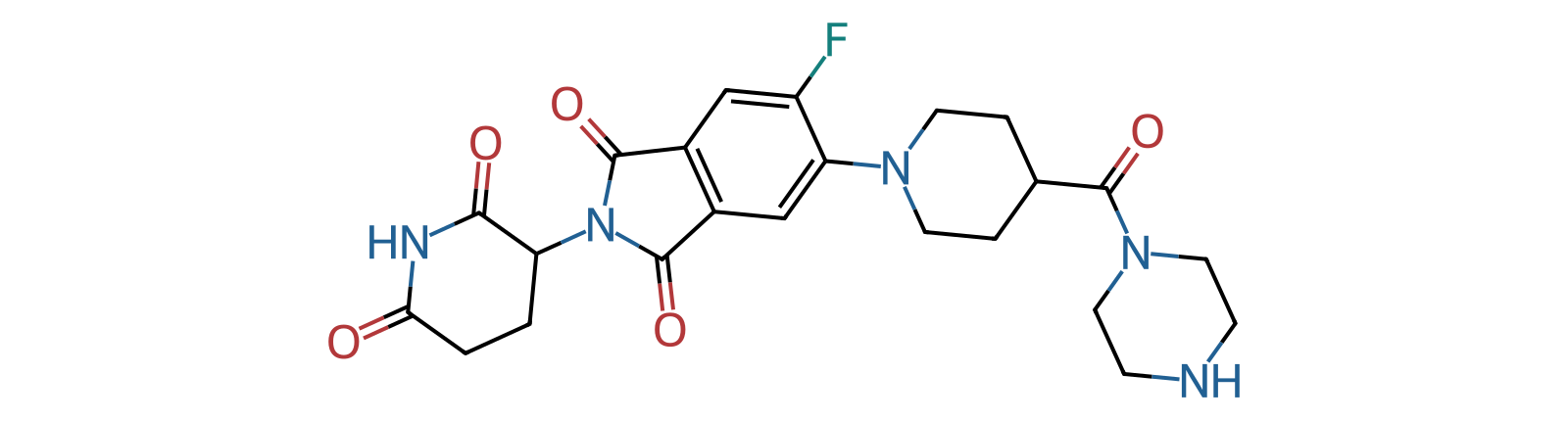
Understand the role of the component
A conventional heterobifunctional PROTAC combines a target-binding moiety and an E3-ligase-binding moiety through a linker. Its intended mechanism involves bringing the two proteins into proximity. The behaviour of the complete molecule cannot be inferred solely from the presence of those parts.
A purchasing brief might concern a ligand derivative, a linker-bearing component or another functionalised building block. State the role you need explicitly. A catalogue description does not by itself establish E3-ligase engagement, target binding or protein degradation.
Sources: Targeted protein degradation: expanding the toolbox (2019)
Attachment site and linker details are central
Specify the atom or position used for attachment and the required functional group or protecting group. Do not substitute a positional isomer without considering the intended structure. If linker-bearing variants are useful, describe acceptable changes in length, composition and terminal groups.
PROTAC design is sensitive to the complete molecular architecture. Research has demonstrated that linker selection can be investigated experimentally using different building blocks. That is a reason to make your selection brief precise, not evidence that any particular HTS entry will produce an effective degrader.
Sources: Discovery of a CNS active GSK3 degrader using orthogonally reactive linker screening (2025)
Evaluate the HTS example as chemistry
HTS059439 is a highlighted PROTAC building-block example in the collection. Open its product record and inspect the exact structure and catalogue data. The category identifies a curated chemical example; it is not an exhaustive classification of the collection or a biological activity claim.
Use exact search for a specified component and substructure search to explore related chemistry. Calculated descriptors can help organise a shortlist, but they do not measure cellular exposure, ternary-complex formation or degradation performance.
Send a complete component specification
Request a quotation for your selection or larger quantities by email. For virtual entries, agree synthesis feasibility and specifications before scheduling downstream work.
- Compound ID and exact structure, with the intended attachment point identified.
- Required stereochemistry, salt or free form, and protecting-group state.
- Linker features and reactive handles that must be preserved.
- Amount per compound, acceptable analogue variants and available documentation required.
- Whether you are enquiring about existing stock or a synthesis-required entry.
Common questions
Is HTS059439 a validated protein degrader?
The site presents it as a PROTAC building-block example. This label does not establish biological activity or degradation performance.
Can a building block predict the activity of the final PROTAC?
No. The complete structure and the experimental system matter. Evaluate the final molecule with suitable research methods.
Sources & further reading
YOUR NEXT STEP
Find chemistry to evaluate.
Explore the catalogue or send your IDs, quantities and specifications for a tailored quotation.
Catalogue information is distinct from experimental activity data. Counts refer to entries; categories can overlap. Availability, documentation and synthesis feasibility are confirmed individually. Questions or corrections? Email the team.