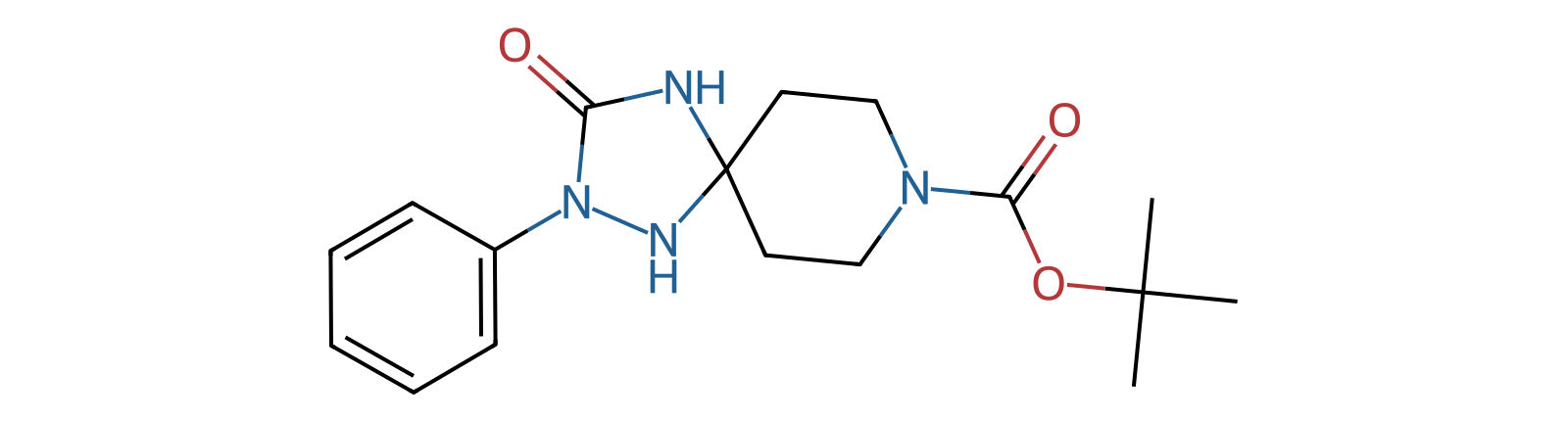
A spirocyclic system has rings joined through one shared atom. Such scaffolds can provide a different arrangement of substituents from a planar aromatic core. Evaluate the specific ring system, functional groups and stereochemistry; a spiro motif alone does not establish useful biological properties.
A change in molecular architecture
Spirocyclic chemistry is one way to explore molecular shape and substitution vectors. Ring sizes, saturation and heteroatom placement influence the structures you can build from a scaffold. Two compounds described as spirocyclic can have substantially different geometry and chemical behaviour.
Research on saturation and molecular properties helped motivate interest in less planar chemical space. That does not mean a spirocyclic compound is automatically superior to an aromatic analogue. Use the scaffold to test a specific structural hypothesis, then assess the resulting compounds experimentally.
Sources: Lovering, Bikker and Humblet: Escape from Flatland (2009)
What to compare before selecting a scaffold
Draw the required system rather than relying only on a name. A substructure query can help retrieve related ring systems, but inspect each complete structure to check the placement of the groups you need.
- The sizes of the rings sharing the spiro atom.
- Which rings are saturated and which contain heteroatoms.
- The position, number and accessibility of functional groups.
- Protecting groups, salt form and any specified stereochemistry.
- How the chosen attachment positions fit your intended analogue series.
The spirocyclic collection at HTS
The current in-stock collection includes ≈ 1,600 spirocyclic catalogue entries. Some are also building blocks or members of other collections. These categories overlap; the count does not describe an equal number of unique scaffolds.
Use Collection → Spirocyclic together with the chemical attributes and structure search. For a synthesis route, also review the building-block classification and the full structure. The label alone does not confirm that a compound is a suitable reagent for your particular transformation.
Turn a scaffold idea into a sourcing request
Send a drawing or SMILES, the required substitution positions and the amount you need. State whether a protected form is acceptable and keep any required stereochemistry explicit. If a close analogue would be useful, explain which changes are acceptable.
Stock quantities and documentation are confirmed individually. Virtual library entries are marked synthesis required and should be treated as a feasibility enquiry. For a larger scaffold selection, ask for a volume offer based on the shortlist.
Common questions
Are all spirocyclic compounds chiral?
No. Chirality depends on the symmetry and substitution of the complete molecule. Inspect the encoded stereochemistry rather than inferring it from the spiro label.
Is fraction sp3 the same as a spirocyclic classification?
No. Fraction sp3 describes the proportion of carbon atoms with sp3 hybridisation. Spirocyclic describes the way rings share an atom; these are different structural concepts.
Sources & further reading
YOUR NEXT STEP
Find chemistry to evaluate.
Explore the catalogue or send your IDs, quantities and specifications for a tailored quotation.
Catalogue information is distinct from experimental activity data. Counts refer to entries; categories can overlap. Availability, documentation and synthesis feasibility are confirmed individually. Questions or corrections? Email the team.